
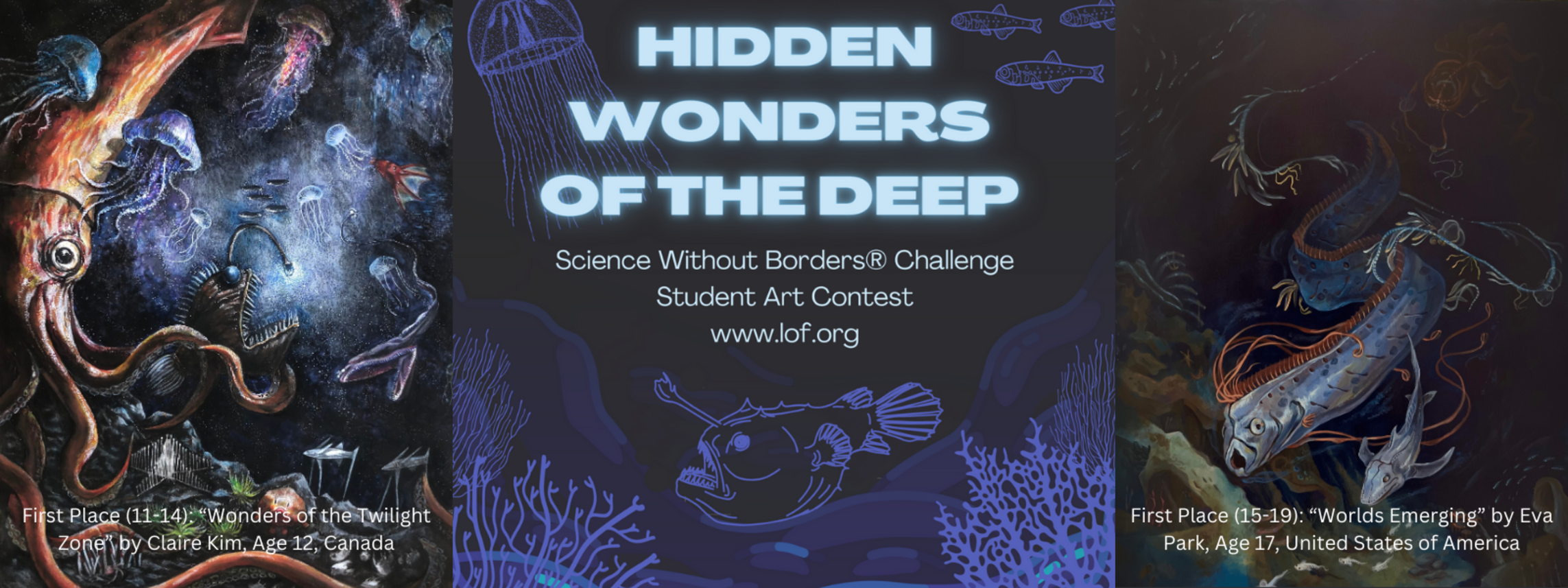
2024 Science Without Borders® Challenge Winners
EarthEcho’s partner, Khaled bin Sultan Living Oceans Foundation, is thrilled to announce the 2024 Science Without Borders® Challenge winners!
The Science Without Borders® Challenge unites young artists and ocean conservation advocates worldwide and highlights their talent and dedication to safeguarding our oceans.
This year’s theme, “Hidden Wonders of the Deep,” inspired students aged 11-19 to showcase the mysterious and diverse marine life thriving in our ocean’s depths. The competition received an impressive 1,700 entries from 82 countries, emphasizing the global interest in ocean conservation and creativity.
Artwork was evaluated in two age categories (11-14 and 15-19), showcasing beautiful depictions of deep-sea organisms and ecosystems. These winning entries vividly capture the significance and beauty of the deep sea, emphasizing the urgent need for conservation efforts.
Keep reading to check out the winners of this year’s challenge!
Winners Ages 11-14:
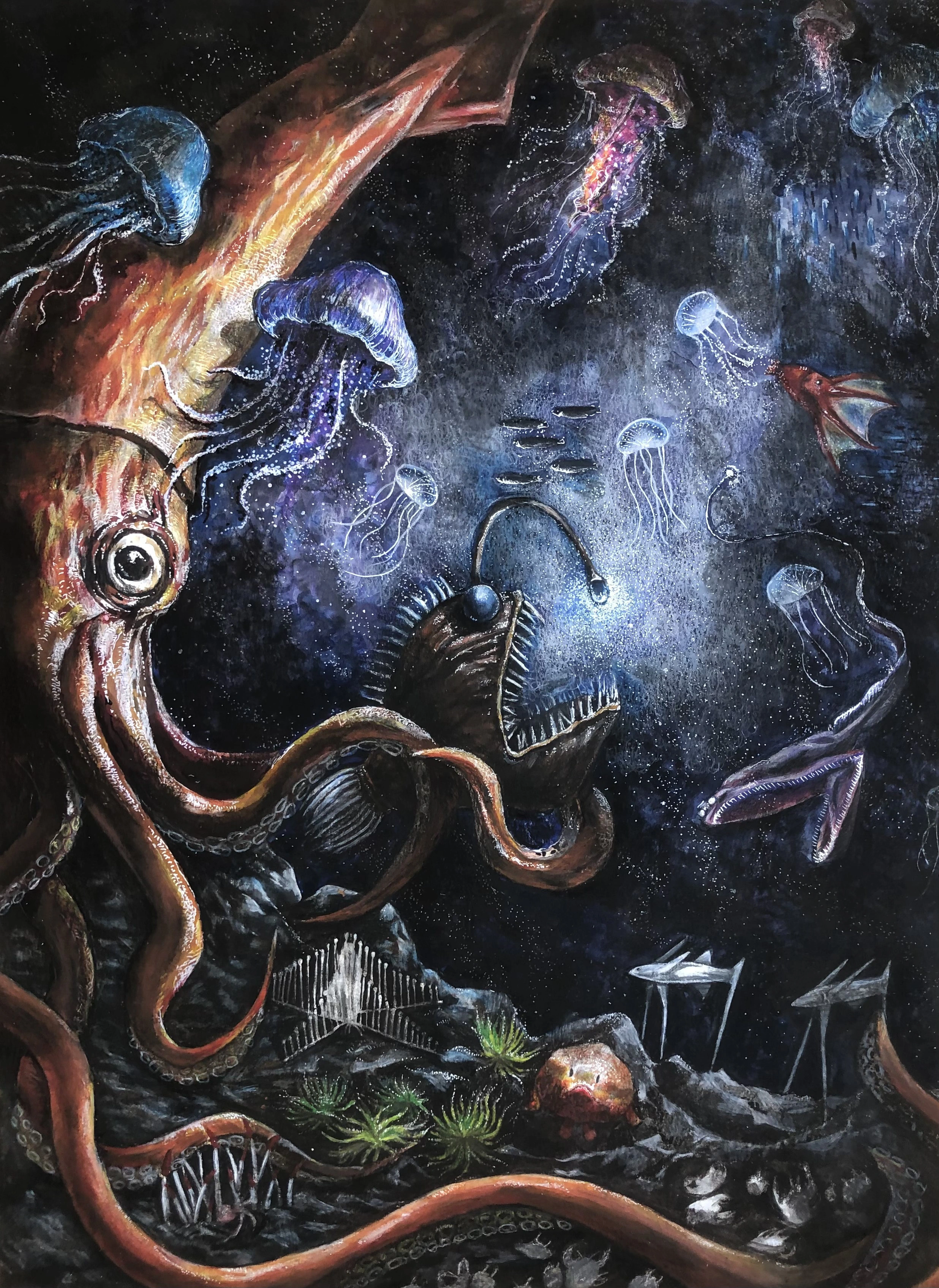
1st Place: "Wonders of the Twilight Zone" by Claire Kim, Age 12, Canada
Artist Statement- Under the deep sea where it is a dark world full of mysteries, there are weird creatures we have not seen. When we think of the deep dark parts of the ocean, the creatures that come to mind usually look unattractive, bizarre, or very unsettling. However, deep down in the twilight zone, it is like various colours of fireworks. You can find life with vibrant pinks and blues like a whole new dimension with its own beauty and mysteries. Some even carry light and grace upon seeing them. When a light is lit in the twilight zone, we can see the many charmers who have been hiding in the dark. The deep sea is not all about the big, scary, ugly, or distorted-looking creatures, it is about a magical world full of beauty and mesmerizing sights to behold.

2nd Place: "Don’t Follow the Light" by Cheong Wong, Age 11, China
Artist Statement- Deep, cold, and dark, this mysterious and unknown deep-sea world has the largest unknown biological system on Earth. It's pretty ugly which name is anglerfish. It lives in a dark world where the sun is completely out of reach, where the water depth is more than 1,000 meters and its eyes have degenerated and shrunk. The food falls from the sea becomes less and less, it has evolved a huge mouth in order not to miss the scarce food. It uses sensitive hair on its body to sense the flow velocity of surrounding water. It has a long bait ball on its head, which emits a faint glow in the darkness and lures prey, when it feels the prey approaching, it immediately opens its huge mouth to suck in the prey with the seawater.I hope awaken everyone to cherish the magical beauty of colorful life in this dark kingdom on Earth.
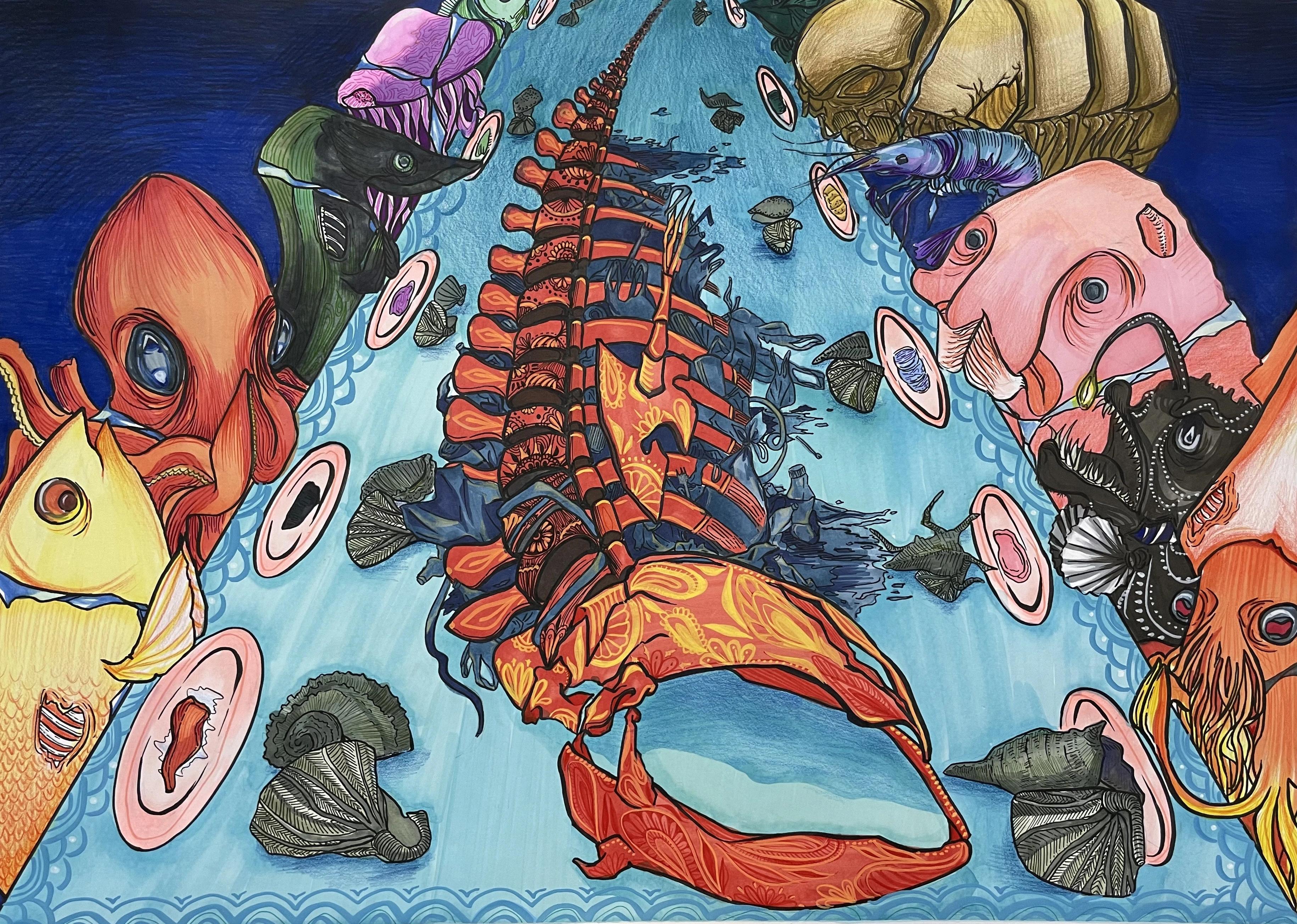 3rd Place: "Praying" by Felicia Fang, Age 14, China
Artist Statement- In the past days, whale fall provides a great amount of nutrition for the marine animals, making the ocean full of vigor. The decorations on the skeleton present the beauty of life. However, under the gorgeous skeleton, there’s tons of trashes and plastic objects, creating a strong contrast. As sea pollution is increasing, life is even more difficult for the deep-sea animals due to the lack of foods. Only depending on a whale fall cannot support the survival of all deep-sea creatures. Therefore, they decide to transfer the hope from depending on a whale fall to save themselves on their own. The plastic tie around every creatures’ neck alerts them of this disaster, also reminding them to fight together. They share a part of their body to the others, praying for the end of this disaster, praying for the human being to leave a way out for them.
Winners Ages 15-19:
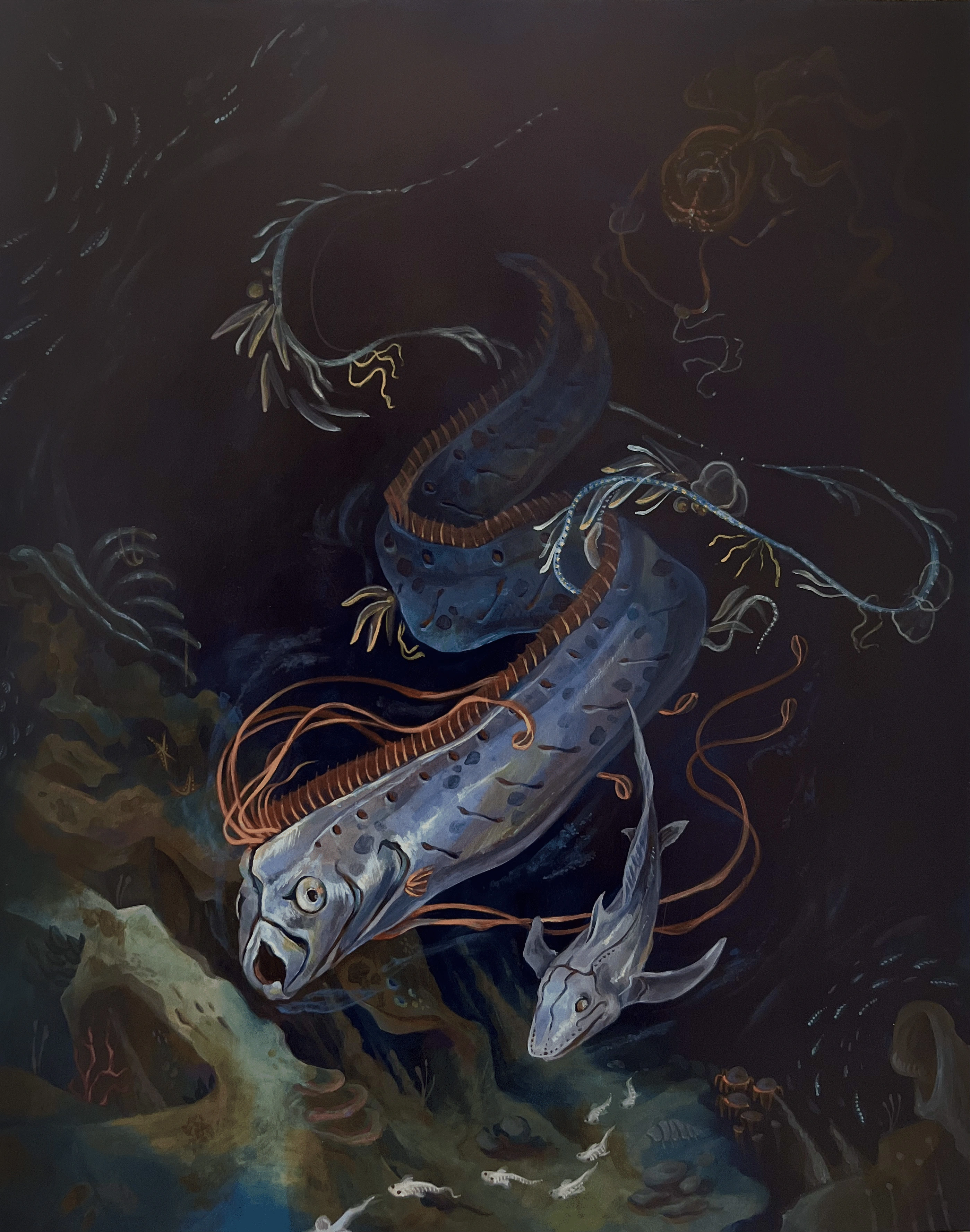
1st Place: "Worlds Emerging" by Eva Park, Age 17, United States of America
Artist Statement- The deep sea holds a plethora of mysteries, many of which are haunting and horrifying. Yet, it sparks fascination with its endless opportunity for discovery. The oarfish emerging from the dark represents the discoveries we have already made, and the siphonophore looms as a reminder of the otherworldliness often found in deep sea creatures. The darkness that shrouds both suggest that there is still much to uncover however. The darkness is not an indicator of lifelessness but is pregnant with possibilities. This feeling of mystery but intrigue is further emphasized by the vast biodiversity hidden in the dark, such as the chimera shark, atolla jellies, schools of lantern fish, hadal snailfish, and the whale remains glinting in the background. Finally, the single light source coming from the viewer's perspective shows the startle and wonder one might feel in discovering and witnessing such creatures swimming by in the dark depths.
2nd Place:"Under the Sea" by Nadia Cho, Age 16, United States of America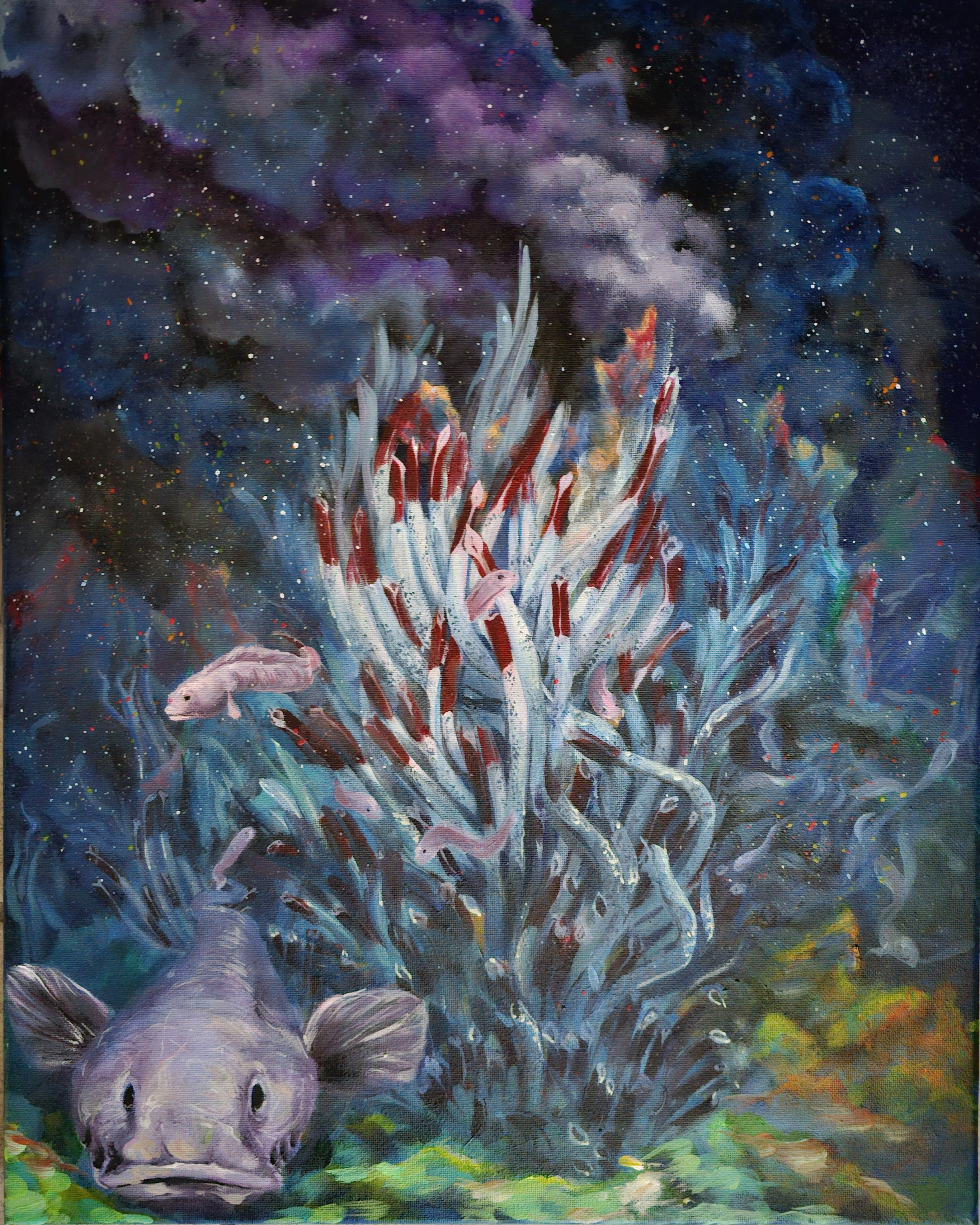
Artist Statement- "In the bathypelagic zone, tubeworms rest around hydrothermal vents. These tubeworms may seem a little grotesque by their mass numbers, but they are important for the surrounding life by the hydrothermal vents. The tubeworms have a symbiotic relationship with chemosynthetic bacteria inside their body. As the tubeworms transfer hydrogen sulfide from the vent water, the bacteria convert the hydrogen sulfide to food that the tube worm can eat. Since there are many tubeworms, it provides a perfect shield to the Zoarcid fish who seek shelter from predators in the deep. Although the tubeworms may provide safety for a few species, they reminded me of the corals in coral reefs and how they provide the same thing for many different species. Hence why I illustrated the type of ecosystem the tubeworms live in and emphasize the beauty of its ecosystem."
3rd Place: Third Place (15-19): "Look Into The Light" by Jiayi (Jenny) Xu, Age 15, United States of America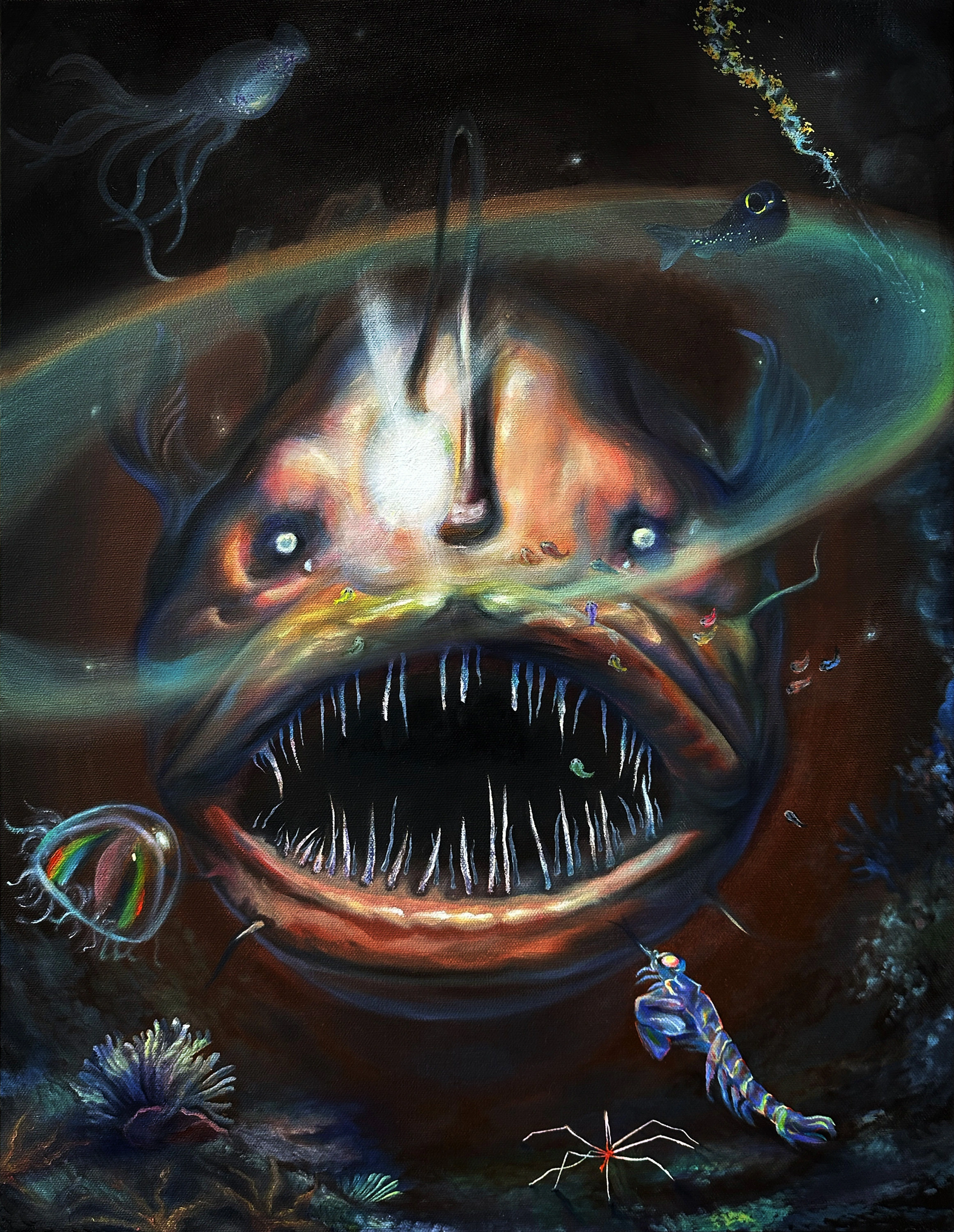
Artist Statement- For this painting, I created an ominous, frontal composition of an angler fish luring its surrounding creatures such as mantis shrimps and squid. I imagined what it must be like to live in an environment with the absence of light that’s filled with danger lurking in every corner. The bioluminescent lure of the angler fish creates light where there is none, becoming a transcendent object of otherworldly admiration/impending doom for those that become hypnotized by its wonder. The scene is emphasized by the hydrothermal vent and the imagined light rings that would both blind and captivate the unsuspecting prey. I also recently stumbled upon brand new discoveries of previously unknown species in the abyssopelagic zone under the sea as well as in Chile that I incorporated into my piece. In researching the deep seas, I was truly amazed at how forms of life can not only adapt to extreme environments.
Honorable Mention:
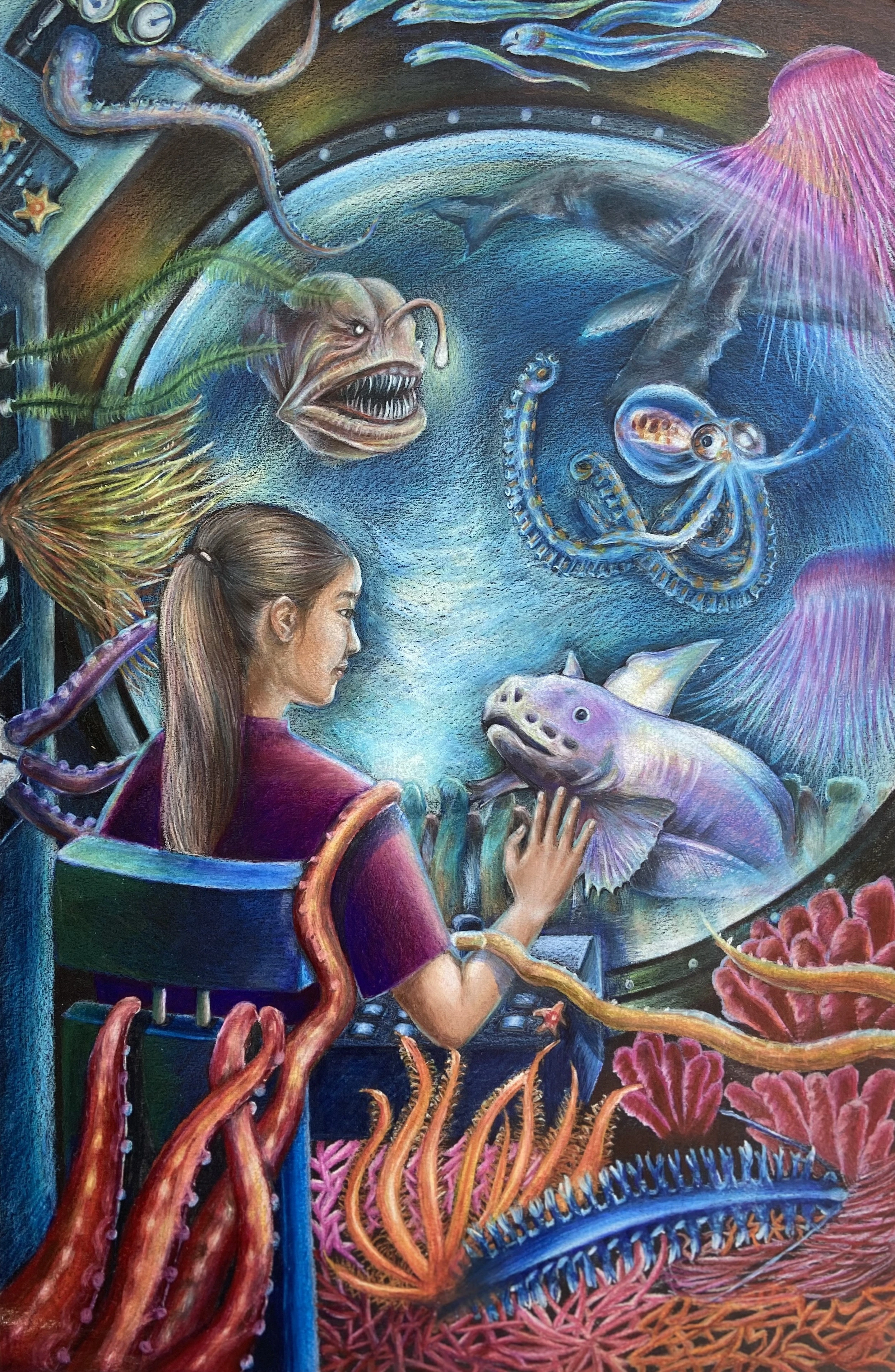
"Discovering the Undiscovered" by Chloe Jeong, Age 14, United States of America
Artist Statement- My artwork depicts a deep-sea ecosystem that contains snailfish, bioluminescent jellyfish, anglerfish, reefs, whale fall, squid, eel, and marine worms. There is a person exploring inside a deep-sea submersible, which exhibits the methods humans utilize to unveil the mysteries of the deep. The fascinating deep-sea organisms are located inside and outside of the deep-sea submersible. This represents how humans and the creatures of the deep sea are both on Earth but are barred from interaction due to the extremely different environments. Furthermore, my artwork illustrates a person inside the submersible closely observing a snailfish, which was recently discovered for being the deepest living fish. This represents that although the deep sea is mostly unexplored, more hidden wonders of the intriguing ecosystem are gradually being brought to light.
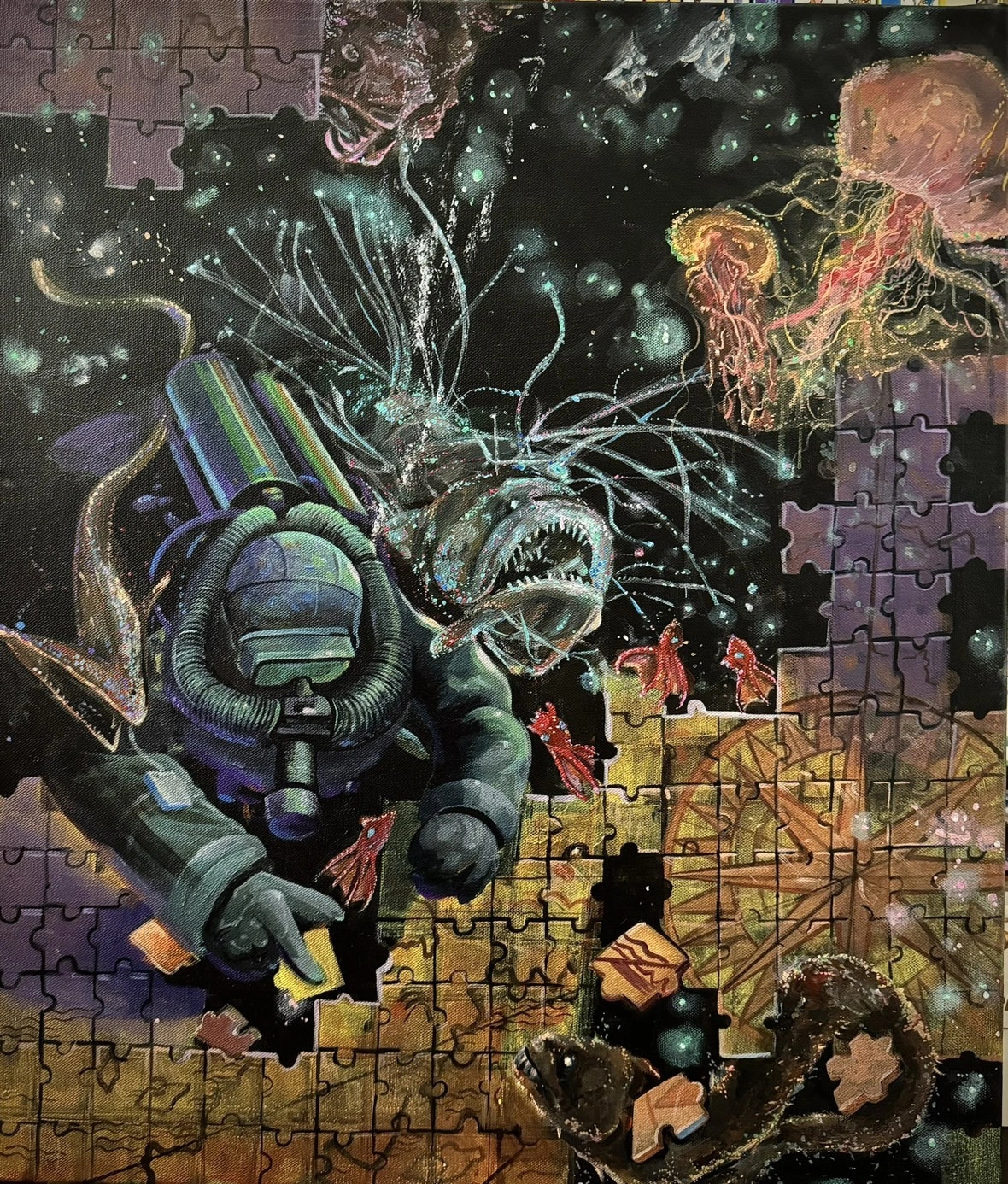 "Glowing Allure from the Deep" by Zoe Cheng, Age 17, Taiwan
Artist Statement- My artwork unveils the unique beauty of the ocean's depths, with a focus on the Mesopelagic and Bathypelagic zones. Through vibrant portrayals of creatures like the Anglerfish and Gulper Eel, I aim to showcase their fascinating adaptations. Puzzle pieces symbolize the mysteries awaiting discovery, while the diver represents humanity's intention to coexist with these creatures. Each organism, from the Vampire Squid to the Lion's Mane Jellyfish, embodies the diversity of the deep sea. I play with the unique aesthetic of bioluminescence, drawing attention to prey and enabling navigation in the dark to highlight the diverse adaptations of these creatures. Additionally, this exploration not only enhances ocean literacy but also serves as an inspiration for youth to pursue careers in STEM fields, fostering a clearer understanding and stronger connection to the 'hidden wonders of the deep'.
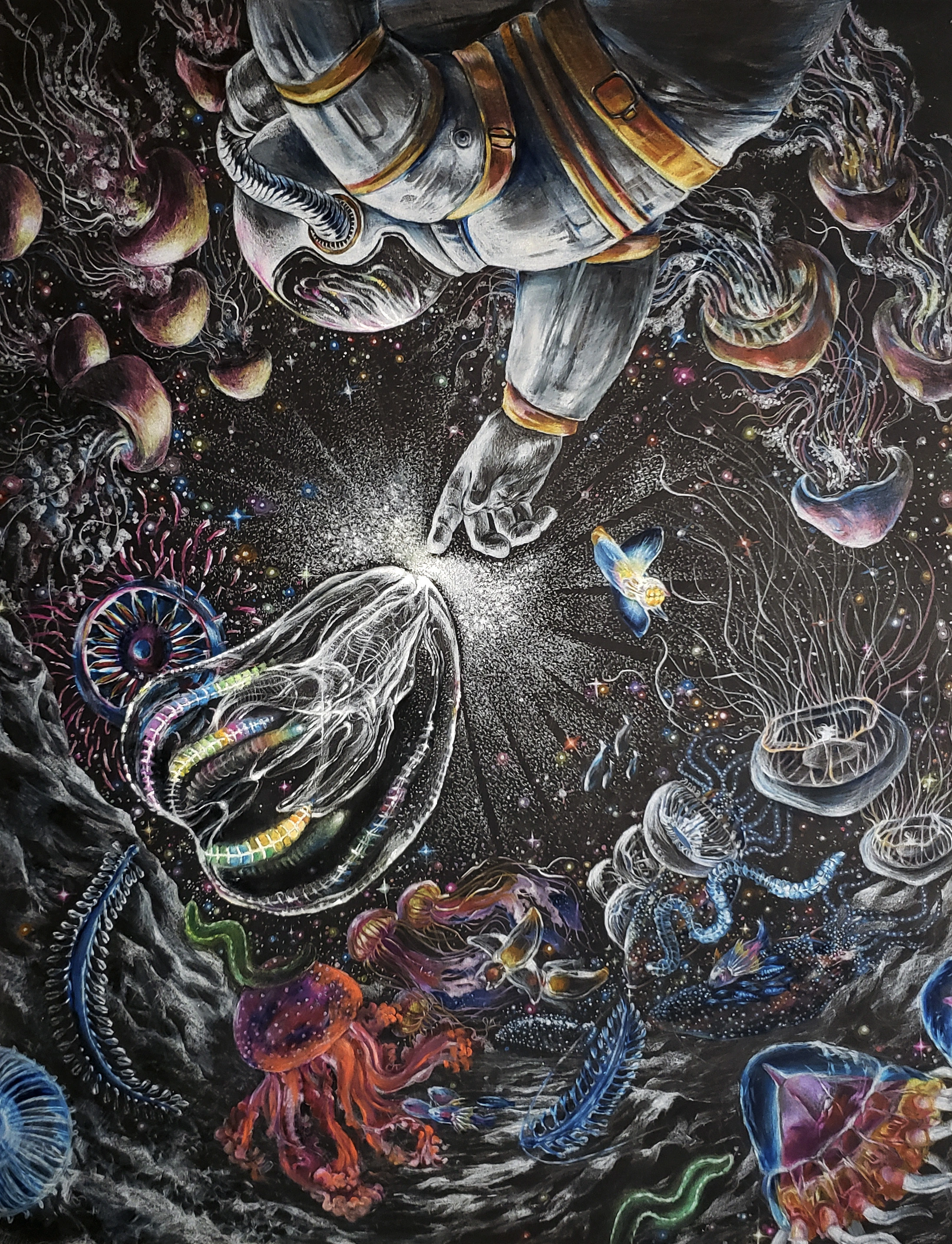
"Nature’s Wonderland" by Sarah Peng, Age 16, Canada
Artist Statement- Contemplating the deep sea often conjures images of unsettling creatures with sharp fangs and distorted features, yet this perception obscures the true beauty of the unknown: the continuously unveiled universe of bioluminescence. In my piece, I aim to highlight the misunderstood charm of its creatures, depicting the collision between the known human realm and the colorful fantasy of the deep sea. As the diver, representing humanity's still developing knowledge, reaches towards a comb jelly’s frame, epitomizing the foreign world of bioluminescence, radiant light scatters across the darkness, symbolizing the beauty of connection. Surrounding them are sea angels, Atolla jellyfish, gossamer worms, firefly squid, Halitrephes maasi, and crystal jelly, showcasing the remarkable diversity of this seemingly empty region. Thriving in specific conditions between the mesopelagic and abyssalpelagic zones, they symbolize the beauty of untouched life. The comb jelly, notoriously fragile and delicate, highlights the flawless balance of the natural world.
Interested in learning more about the Science Without Borders® Challenge? Click here to read more.